
Efficient, slightly lucky, less dynamic: Numbers, with context, behind Arne Slot's tweaks
Liverpool are unbeaten in five league games, but are Slot's fixes only good for short-term gains?

Written on 24/12/2025
After being humbled 3–0 by Nottingham Forest and 4–1 at home by PSV just after the final international break of the calendar year, things looked ominous for Arne Slot and Liverpool.
That pair of results did bring about a certain shift in style and approach from the Reds boss, though, which for now has resulted in the team going six games unbeaten in all competitions, five of those in the league. They have scored 11 goals and conceded five during this run, which sounds good for starters (even if it is not world-beating).
Amidst all this was the Mohamed Salah story, which began just after the 3–3 draw at Leeds United. People seem to have moved on now that Salah is at AFCON and the team is somehow still able to get results on the board, which has seen them creep up to fifth in the table, level on points with fourth-placed Chelsea.
The idea behind this article is to look at the numbers, with context, behind the tweaks Slot has made to how Liverpool are approaching games now and whether this is good for the long term.
We can do this because there has been a discernible shift in how the team has been playing in the league since being beaten by Forest at Anfield. We can look at the underlying numbers across various key metrics and try to make sense of them.
Expected Goal (xG) numbers: less dynamic, more efficient
Something Jamie Carragher pointed out after gameweek one, even though Liverpool beat Bournemouth 4–2, was that this was not a sustainable way of playing. Even during that run of five wins at the start of the season, it felt as if games involving the Reds were “basketball-type” in nature. That is definitely not the way to go if you are aiming to win the major honours, especially the Premier League.
That eventually came back to haunt them in a run of seven games in which they won only one. How have the various xG numbers, from creation to concession, changed from the first 12 league games to the last five? Let’s have a look.
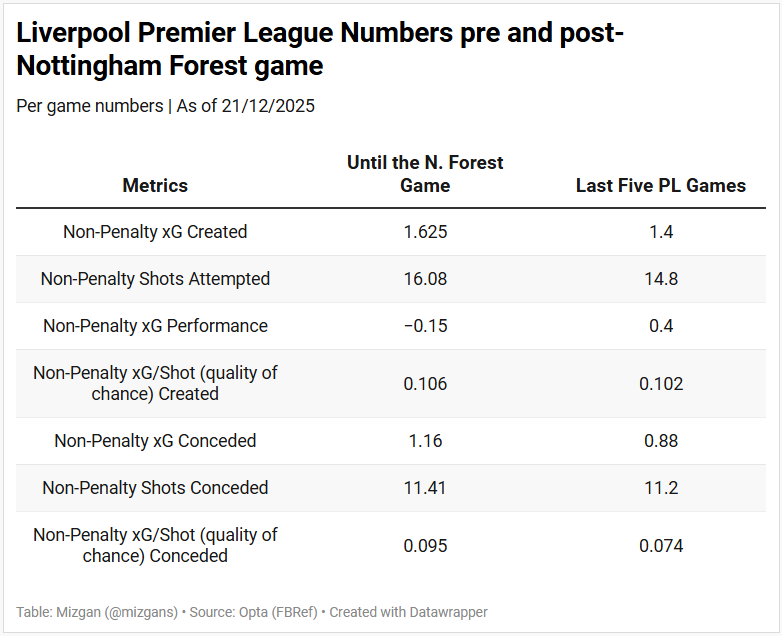
It is clear that, be it a home game or an away fixture, Liverpool over the past few weeks have been approaching matches with the aim of not losing first and then building from the base created. The result of that has been not conceding the first goal of the match in four of the last five games.
What this has done is reduce their overall non-penalty xG creation and shot attempts. They are being more efficient at finishing their chances, though, despite the quality of chance creation remaining similar to the first 12 games.
Although the shot concession rate has not come down by a lot, the non-penalty xG conceded and the average quality of chances conceded have dropped, which would be encouraging for Slot and his staff. The caveat is that, in the first 12 games, opponents overperformed their non-penalty xG by 0.42 per game, while in the last five games they have underperformed by 0.08 per game.
So, teams have stopped overperforming their xG against Liverpool, which should be combined with the fact that the Reds are conceding fewer high-quality chances.
Fewer box entries either way
One of the ways to make football less entertaining is by playing a system that prioritises caution. Slot has chosen that path since the Forest defeat. The reduction in box entries both made and allowed is one way to represent that.
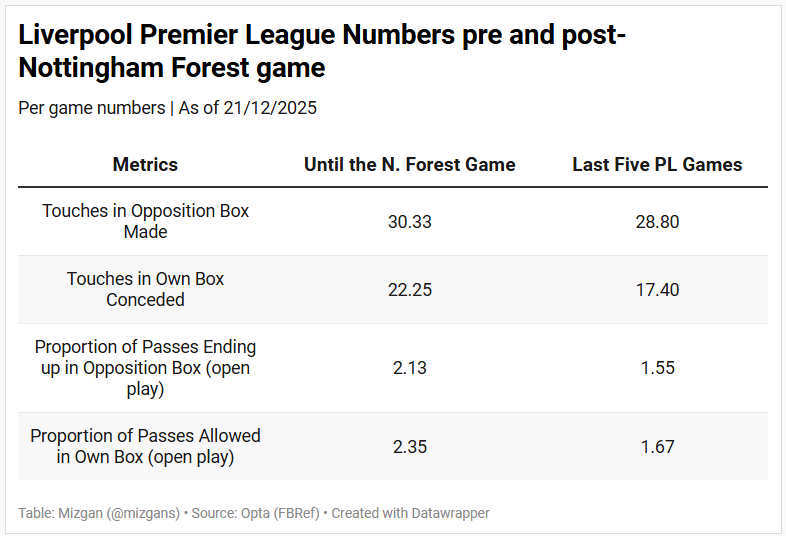
There has been an average reduction of 1.5 touches in the opposition box per game over the last five games compared to the first 12. What’s more, there has also been a reduction of close to five touches allowed in their own box per game too.
With that in mind, it is no surprise that the number of passes ending in either box has taken a hit too.
So, there is an acceptance that Liverpool games have started to take place more in zones outside both boxes over the past few games. While the drop on the concession side is positive, will the cautious approach affecting the other end prove to be a good long-term solution? I doubt it.
The context of teams faced and other numbers
When you look at the numbers, as we have done in the two data tables above, you almost have to be careful drawing conclusions without adding context.
The context here is the quality of the teams Liverpool have faced in the last five league games compared to the first 12. This helps in understanding whether this ‘improvement’ is likely to hold when the proper big games come around. I have also looked at other metrics, which serve as a note of caution against being overly positive.
The rest of this article is for paid subscribers (only £3.50 to access at least six data-driven breakdowns, player and team analysis, scout reports per month; £4 off for an annual subscription).
Keep reading with a 7-day free trial
Subscribe to The Transfer Hub to keep reading this post and get 7 days of free access to the full post archives.