
Data: Curtis Jones has found Stability and 'Progression' in his Game this Season
Amidst the team's poor form, Jones has been one of the standout performers whenever on the field

Written on 12/12/2025
Although Liverpool are in the midst of poor form and off-field drama for reasons we all know, there is a player other than Dominik Szoboszlai who has emerged with credit for his performances on the pitch: Curtis Jones.
Often criticised in the past for inconsistency and not making better use of the ball, as well as struggling with injuries that disrupted his rhythm and progression in recent years, Jones has looked like the best central midfielder in the side after Szoboszlai.
The England international still may not be an automatic starter when everyone is fit, but his current form suggests that Arne Slot should regard him and Szoboszlai as two of the first names on the team sheet when selecting the midfield.
After losing Trent Alexander-Arnold in the summer, Liverpool have struggled to find a connector who can bridge the gap between the centre-backs and the creative or forward players when building passing sequences from the back. Ryan Gravenberch is an excellent player, but passing and build-up stability are not his strongest traits yet. Alexis Mac Allister is struggling for form.
This is where Jones has been valuable for Slot whenever he has started or come on as a substitute. The 24-year-old has been operating almost as a deep-lying playmaker, receiving the ball from the centre-backs and using it well while linking with the forwards and occasionally playing the key pass that unlocks an opposition defence. His off-the-ball work seems to have gone up a level this season as well.
Below, we look at his numbers in context to understand the level he is operating at compared with the last couple of seasons, and to assess how good he actually is relative to his peers in the league this season.
Involvement and Touch Zones
For a deep-lying midfielder, it is important to act as an outlet for the centre-backs when they want to release the ball, and to be available for the wingers or forwards when they need to recycle possession or change the direction of the attack. This is where involvement becomes a key factor.
We will examine that, and also consider any changes in the proportion of touches he takes in key zones for a central midfield player.
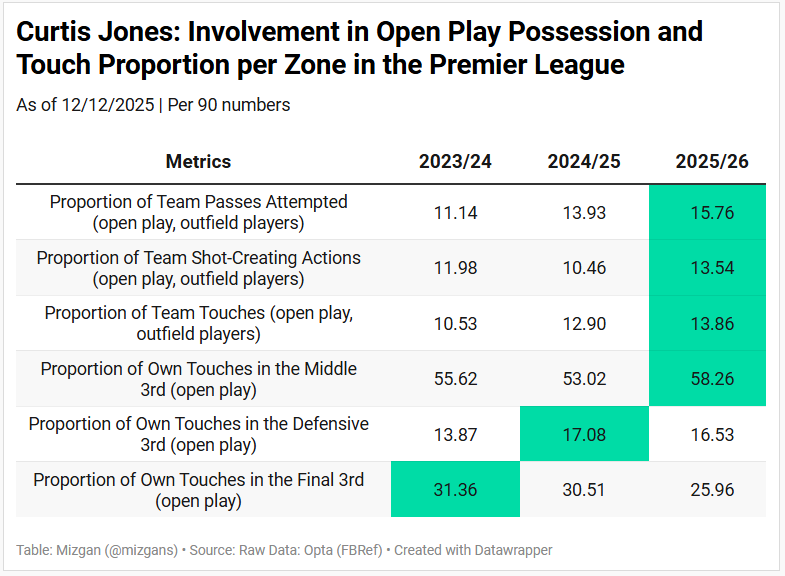
Jones has increased his open-play passes, shot-creating actions, and overall touch involvement by a fair margin this season. It shows that he is able to remain effective on the ball despite seeing much more of it than before. Very encouraging signs.
When it comes to touch proportion per zone, he has gone up a notch with middle third touches this season, which is understandable given the responsibility he has to be that connector between the centre-backs and the creative players and making sure that the team’s build-up do not breakdown much centrally.
The trade-off is the reduction in touches in the final third.
The rest of this article is for paying subscribers (only £3.5 per month, £4 off for annual subscribers).
Keep reading with a 7-day free trial
Subscribe to The Transfer Hub to keep reading this post and get 7 days of free access to the full post archives.