
Data: Breaking down Tottenham’s £180m+ midfield overhaul and whether they 'overpaid'
Spurs have shown ambition by going big for Sandro Tonali and Mateus Fernandes, it feels like an immediate step in the right direction for them

Written on 06/07/2026
Never did I think that Tottenham Hotspur, with no European football, would manage to outdo Manchester United, with all the prestige and Champions League football to offer, in the race for two Premier League midfield signings (I know Mateus Fernandes got relegated with West Ham United, but he was a Premier League midfielder last season).
What’s more, they have managed to splurge close to £185m (approximate figure) to sign two players in a department (midfield) in which they were struggling massively last season: Sandro Tonali from Newcastle United and Fernandes from West Ham. Not only Manchester United, but Arsenal were also interested in the former.
‘Reliable’ reports have kept reiterating the fact that Roberto De Zerbi was a major driving force behind these signings. Although I am not a fan of football managers becoming pseudo sporting directors and almost doing the work of the entire recruitment department at a club, it is also true that managers must have an input into which players are signed. How much was this one-way traffic? Let’s not speculate.
Let’s start our analysis by looking at the percentile ranks of the two players Spurs have signed among Premier League midfielders for the 2025/26 season in key metrics. I have also added the two Spurs central midfielders who played the most league minutes in that role last season: João Palhinha and Rodrigo Bentancur, to the chart to get a general idea of how much of an upgrade the two new signings would represent for the team.
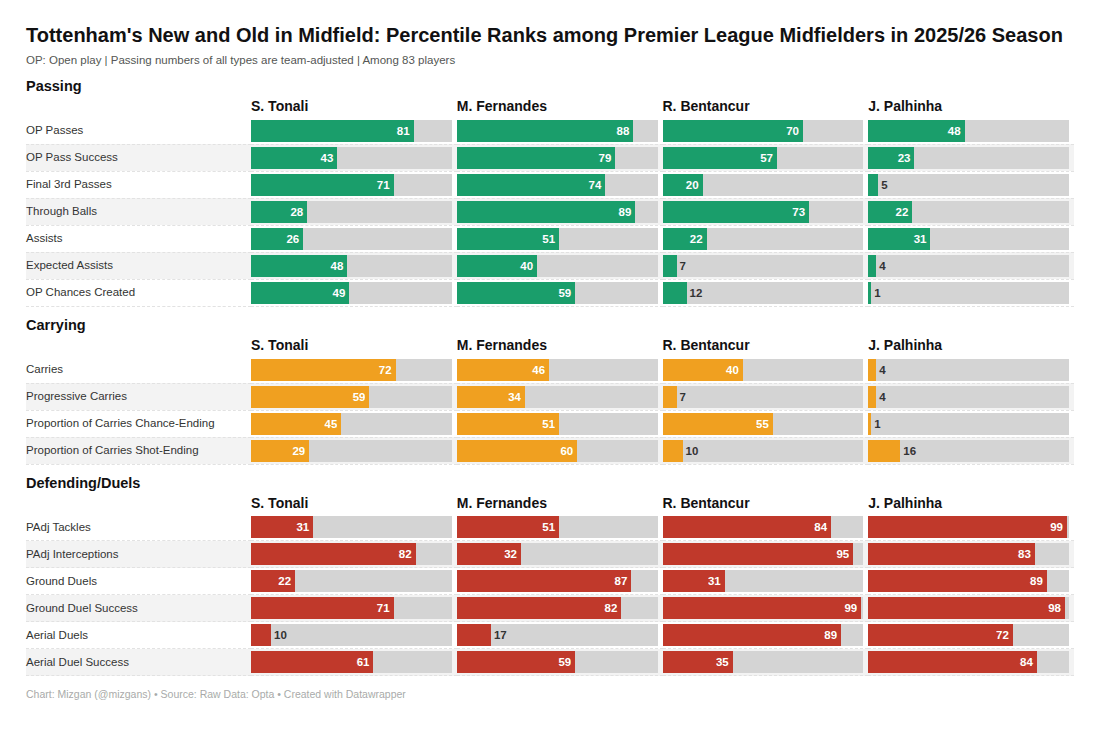
Looking at the overall passing and carrying numbers (even without digging into each metric), it is clear that the additions of Tonali and Fernandes would offer much more on the ball from midfield, whether through passing volume, chance creation, ball carrying or progression. The argument could be that Bentancur and Palhinha played for a struggling team last season, but so did Fernandes, and even Tonali to an extent.
Defensively and in duels, Tonali is good at making interceptions, but his tackling could improve. He does have a decent engine and ranks near the 80th percentile in possession-adjusted ball recoveries. Fernandes, on the other hand, is very good in ground duels, but his overall defensive numbers (including ball recoveries) are a bit dicey. These are the metrics in which Bentancur and Palhinha were considerably better last season.
All in all, Spurs are getting an upgrade in what they offer on the ball in midfield, which suits De Zerbi’s potential desire to play a possession-dominant style of football without losing too much off the ball (although there is still room for improvement).
We now have a broad understanding of what Spurs are getting for their investment in midfield, relative to what they had last season. Next, we will take a closer look at the profiles of Tonali and Fernandes, using event data visualisations to examine their playing styles, zones of action and overall characteristics.
Let’s start with the touchmaps.
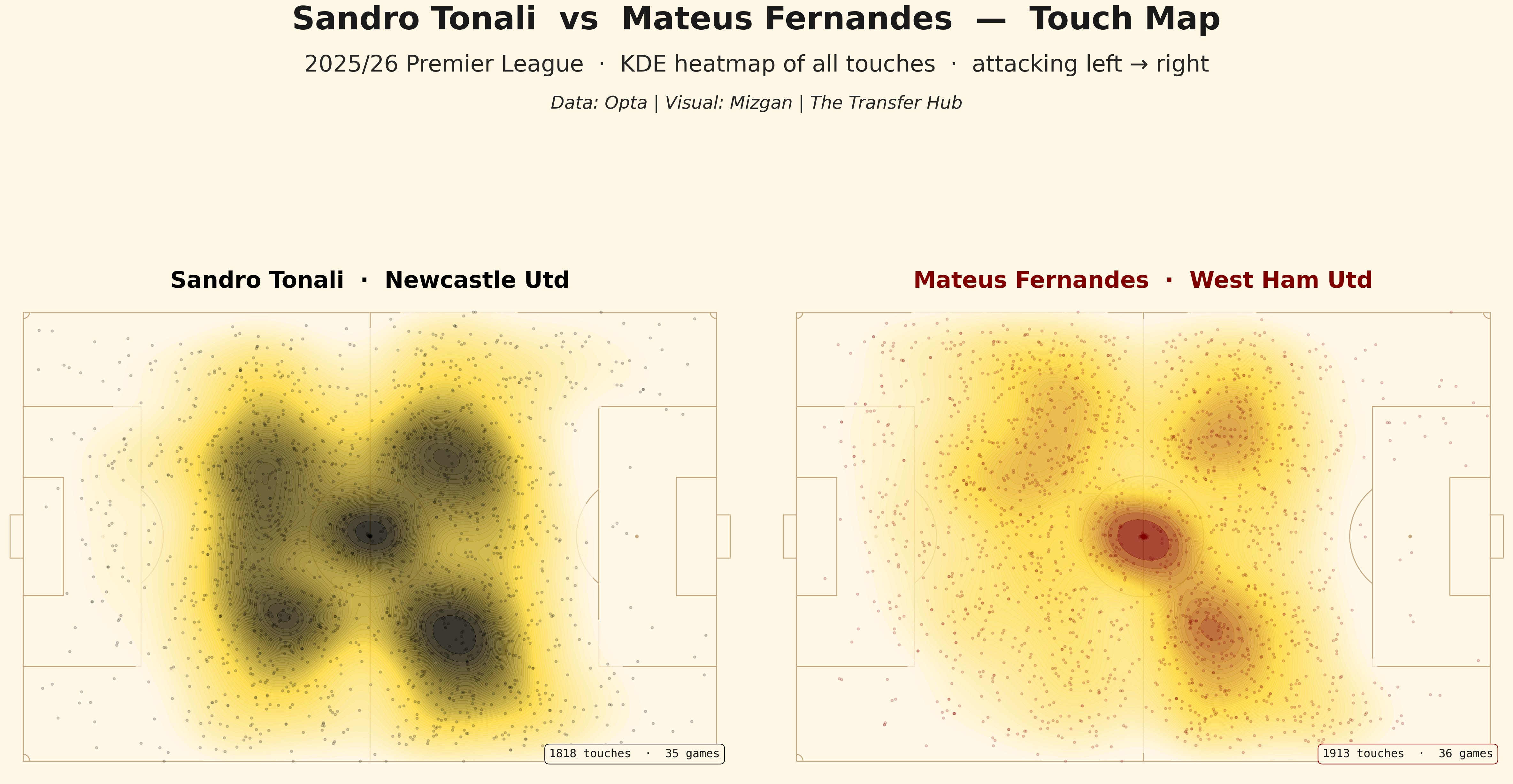
Tonali played as a lone six in a predominantly 4-3-3 system for Newcastle last season, while Fernandes featured in various positions across central and attacking midfield. Hence, it is no surprise that the former has more defined zones of operation, whereas the latter’s are more spread out, reflecting the fact that he was used in different roles for a struggling team.
Next up, respective pass maps:
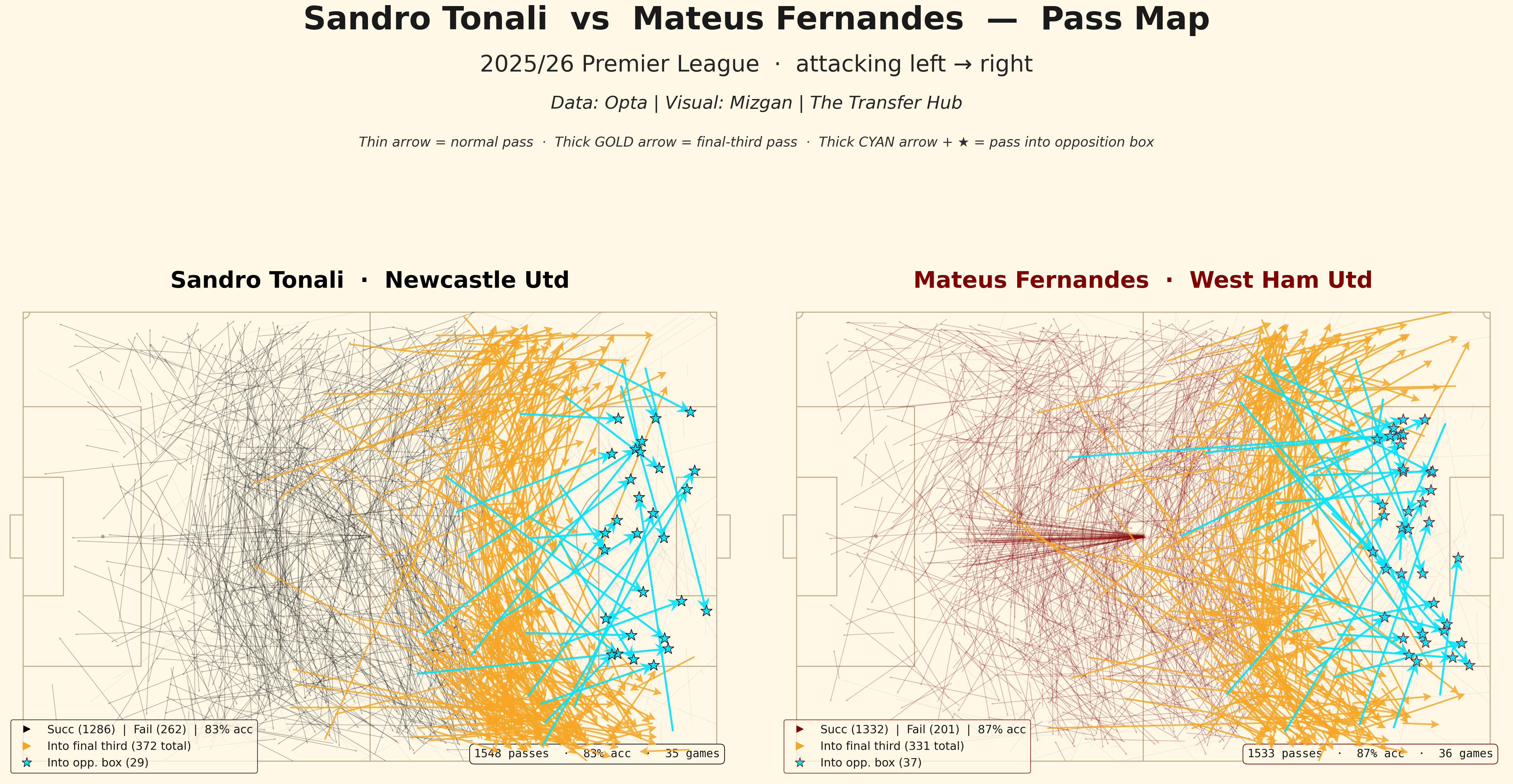
In referential terms, Fernandes made the most open-play passes among West Ham players last season, while Tonali ranked third among his Newcastle teammates, behind Kieran Trippier and Sven Botman. It provides some insight into how the two teams were set up on the ball. While Newcastle looked to build from the back, West Ham placed the onus on their primary midfielder to act as the team’s passing and creative hub.
In terms of open-play chances created and through balls, Fernandes outperformed Tonali last season. That is reflected in the pass maps as well, with the former making a greater proportion of passes into the opposition box and showing slightly more verticality in his passing, with many of his passes ending in advanced wide areas on both sides of the pitch. Tonali’s passing map has a more central focus, which is understandable given the role he was playing.
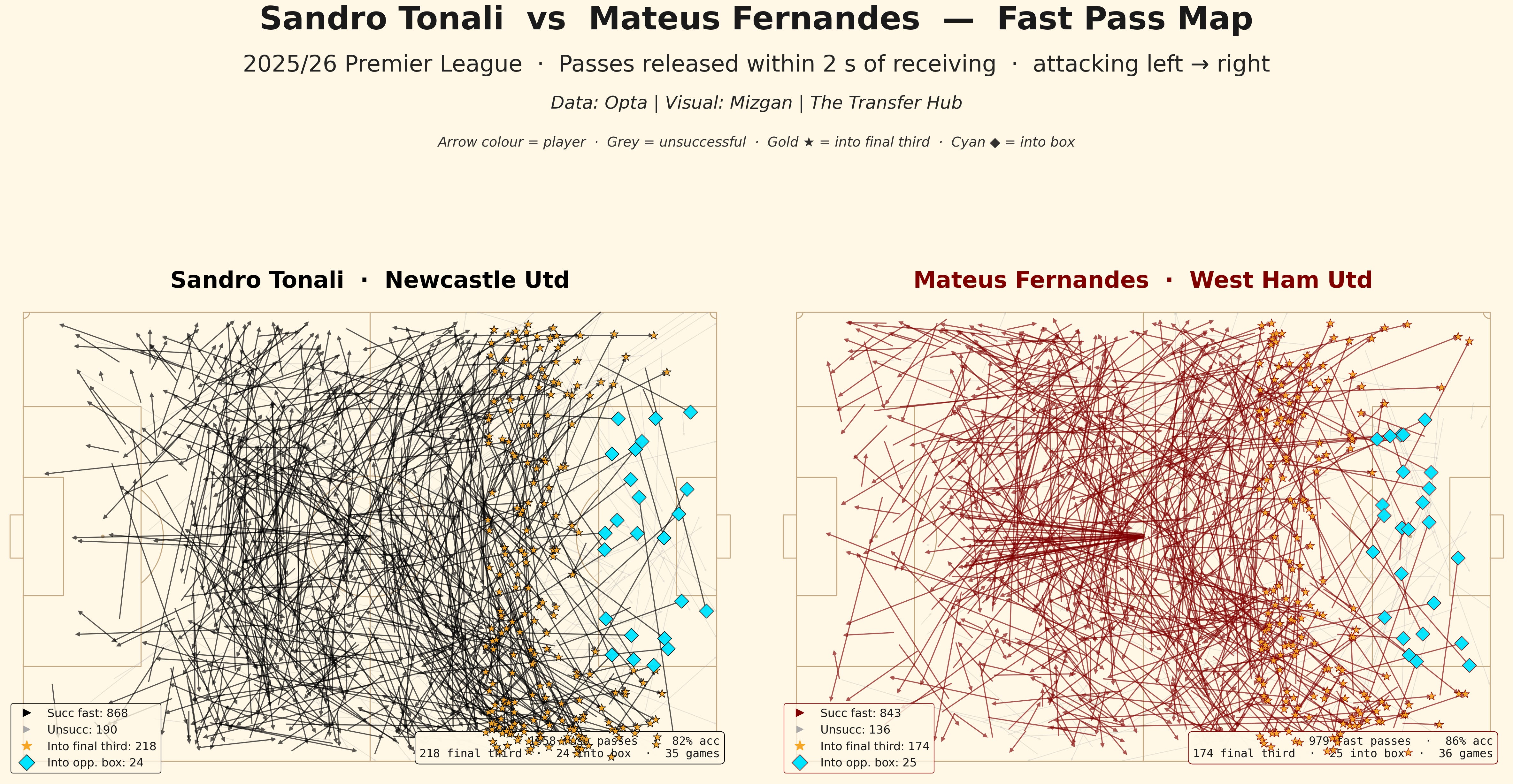
When it comes to releasing the ball quickly or on the first touch, Fernandes maintains a higher accuracy while also putting a greater proportion of those passes into the box. Tonali, understandably, given that he played for a side with an average possession 10% higher than Fernandes’ team, has a higher volume of fast passes/early passes that end in the final third.
It goes back to Fernandes being more vertical in his passing, given that he has the responsibility of becoming the team’s main creator and tempo-setter from midfield, particularly after the departure of Lucas Paquetá in January.
Next up, we have the expected threat (xT) created per zone, ball recovery maps, what their passing looks like after recoveries, and their distance coverage analysis both on and off the ball.
The rest of this article is for paid subscribers (only £3.50 to access six data-driven breakdowns, player and team analysis, and scout reports per month; £3.16 per month for an annual subscription).
Keep reading with a 7-day free trial
Subscribe to The Transfer Hub to keep reading this post and get 7 days of free access to the full post archives.