
Data Breakdown: Why are Premier League clubs chasing Hayden Hackney this summer?
Hackney was the Championship's player of the season for 2025/26, and now Premier League clubs want to sign him

Written on 15/06/2026
Just as Hayden Hackney picked up a major calf injury in the middle of March, after gameweek 38, Middlesbrough were second in the table with 70 points and were among the contenders to get promoted to the Premier League without the playoffs. Although their season was disrupted by Rob Edwards’ sudden departure to Wolves around November, the team settled and gelled well under Kim Hellberg. Hackney played a crucial role in midfield to stabilise things in every way possible.
But in the last eight games of the regular league campaign (after the midfielder’s calf injury), Boro only managed 10 points (14th in the form table) and missed out on the opportunity to get automatically promoted. Hackney also missed the play-off semi-finals against Southampton, which Boro lost; however, they advanced to the final following the fallout from the ‘spygate’ scandal.
The 23-year-old could only play 25-odd minutes of the final as Hull City pipped them to a spot in the Premier League. Now, the Championship’s best player is attracting major interest from an array of clubs in the English top division, including Everton, Crystal Palace and Nottingham Forest.
Let’s look at the midfielder’s numbers in great detail and profile him using event data visuals to understand what he can bring to the table if he moves to the Premier League. We start with his percentile rank bar chart.
Before that, let’s note that Hackney played the majority of the 2025/26 season in a double pivot, either in a 3-4-2-1 or a 4-2-3-1 system. He was seldom used as a number 10 in a 4-2-3-1 or as one of the inside number 10s in a 3-4-2-1. We will explore his action areas when looking at the touch map.
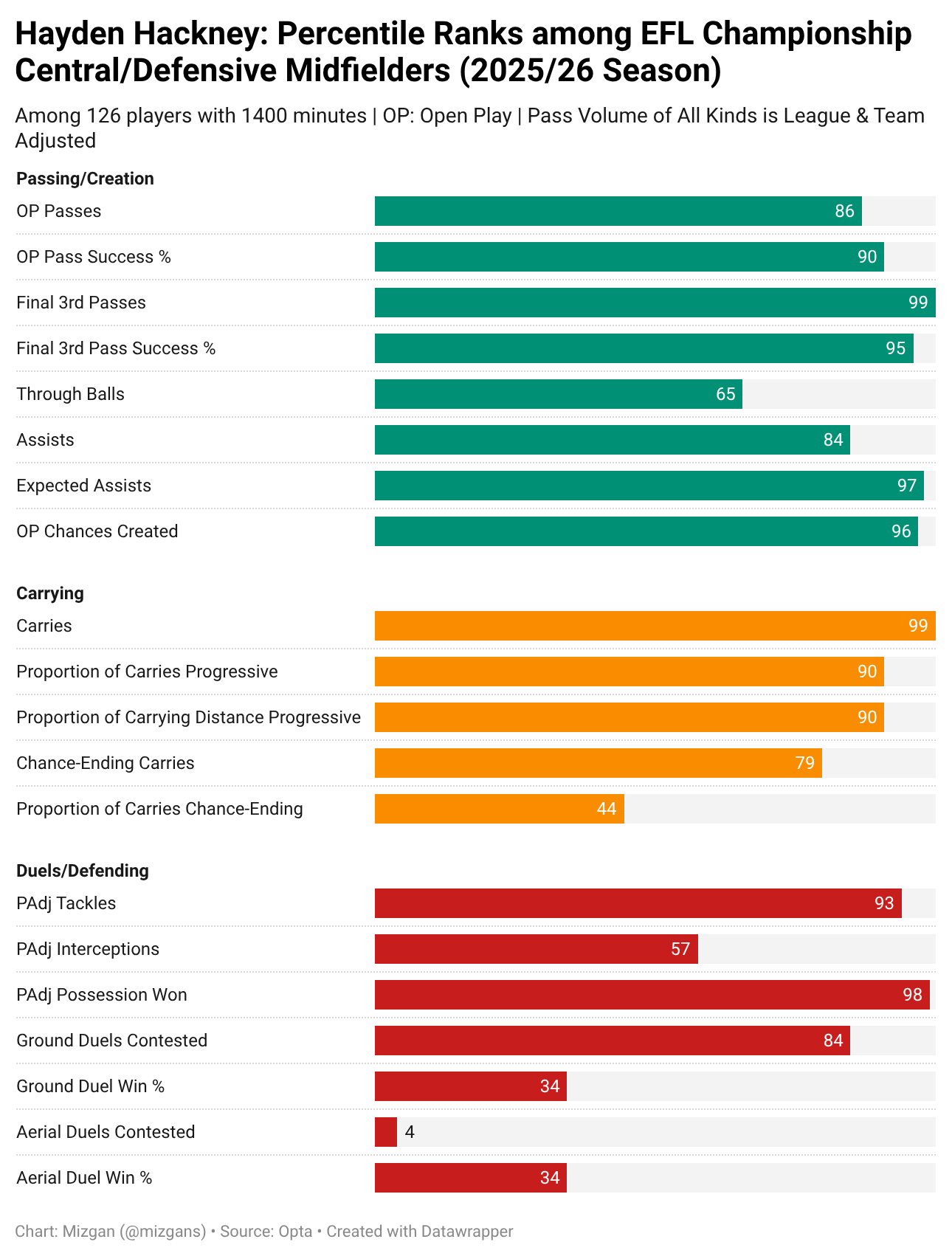
Whether passing securely, progressing the ball, or creating chances through passes and carries, the 23-year-old was in a league of his own among midfielders in the division. In duels and defending, he was pretty good at tackling and recovering the ball. He was not bad in 50-50 ground duels either, although his win rate could have been better. Given how influential he was in so many other areas, we can excuse him for being non-existent in aerial duels (although at 5ft 9 inches tall, he can work on the latter).
Despite missing the last eight league games and both legs of the play-off semi-final, Hackney was very good in a lot of metrics among his teammates as well. Have a look at the table below.
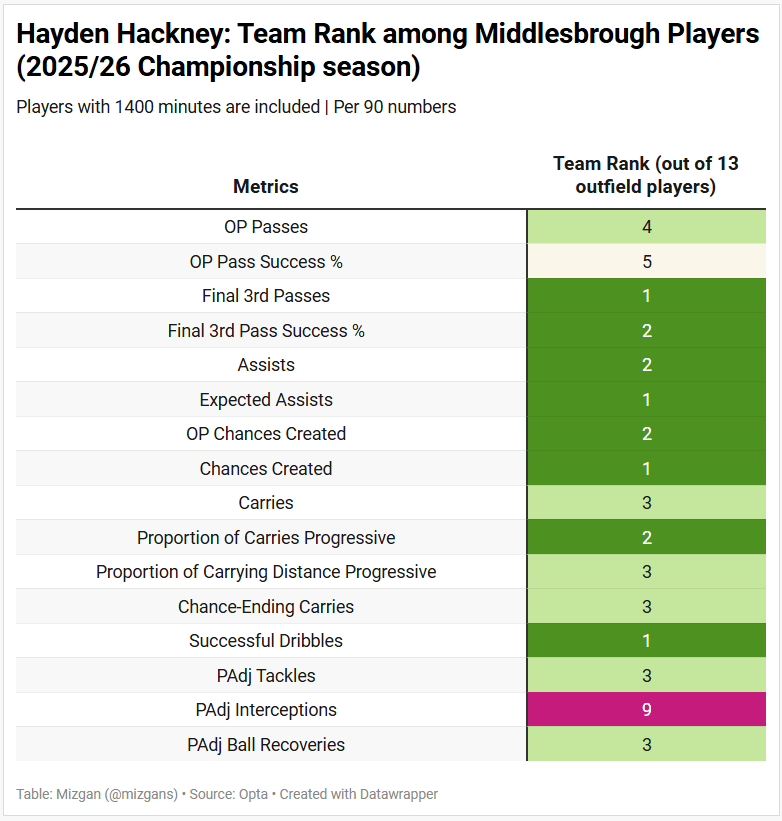
The 23-year-old, who was a youth player at the club before making it to the first team, was outside the top three in the team ranks for only three of the 16 metrics shown above.
It just goes to show how influential he was for the team. No wonder they slipped up in the last eight games of the regular league campaign when he got injured in mid-March.
Next up, we have the event data visuals to dive deeper into the profile and the type of actions Hackney performs on the field, starting with the touch map.
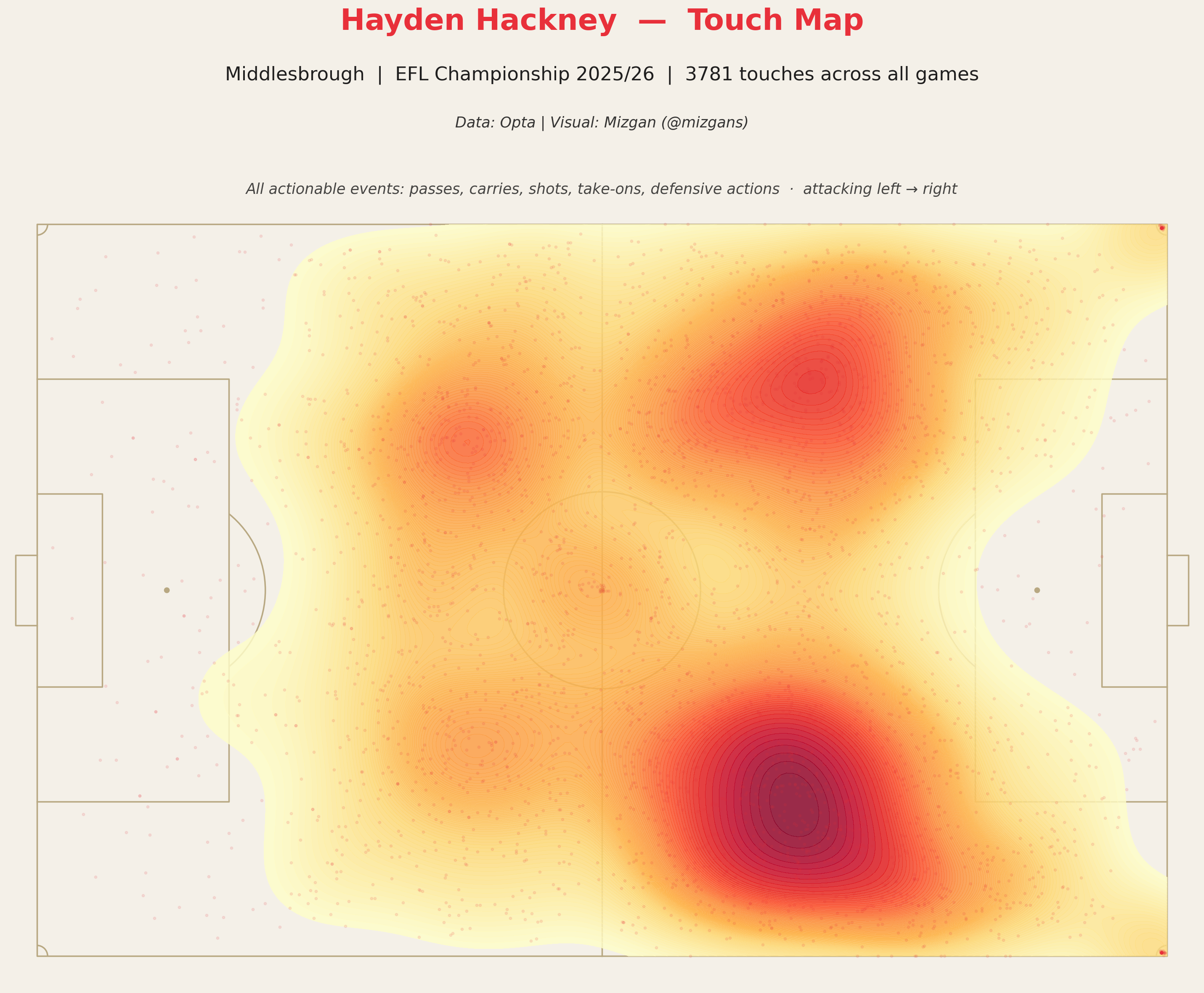
Whether it was Alan Browne or Aidan Morris (the former also played some games at right-back), they did more of the sitting and staying behind the ball, while Hackney became the ball progressor through passes or carries, combining with the attacking players in the final third, even if his starting position was in a midfield pivot. We can see from the touch map above that a lot of offensive work was done, with a cluster of activity 10-15 yards inside his own half as well.
Next up, the pass map and final third passes.
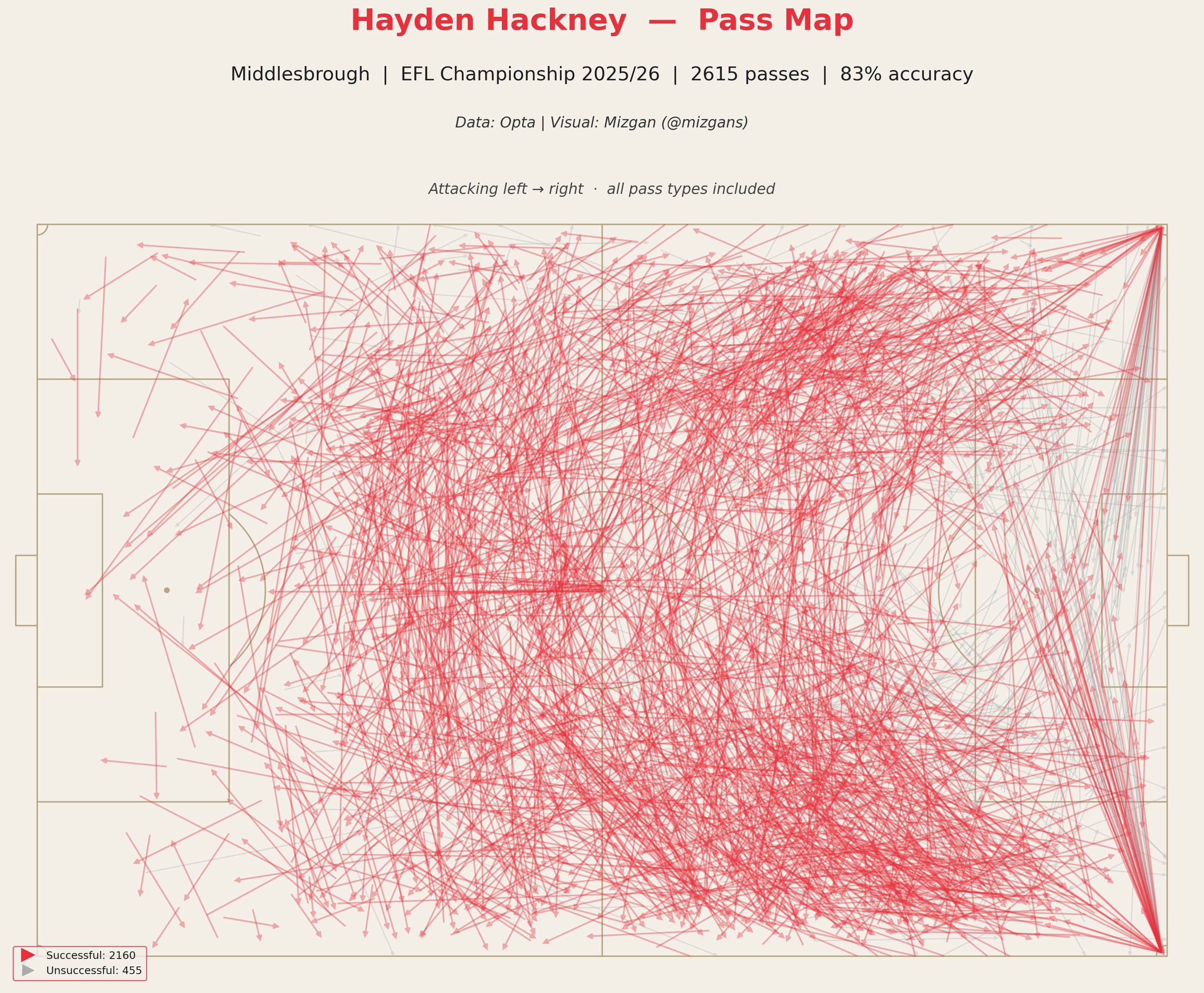
For someone attempting close to 30 final-third passes per 90 and taking corner kicks, it is understandable that the 23-year-old’s overall passing accuracy was below 85%. His open-play passing accuracy was around 86%, by the way, which is above par for a chance-creating central midfielder.
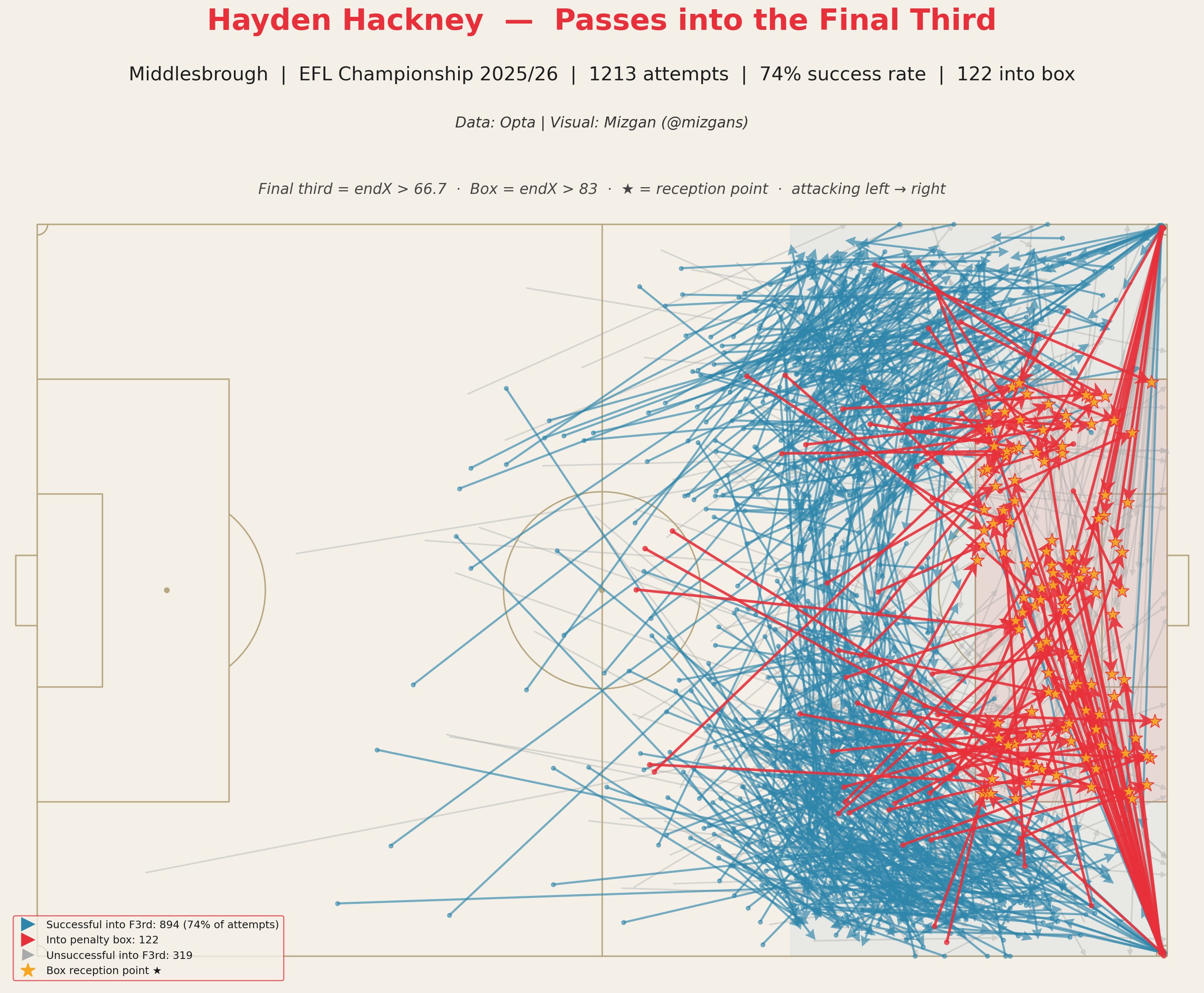
We can mirror this map with his overall touch map. There are a lot of passes originating from the half-spaces on either side of the pitch. These were either slid through for an overlapping player to have a shot or cross, or for him to connect with the winger or full-back on that side. There were also a handful of long-range passes starting from around the halfway line and ending up predominantly on the left-hand side of the final third.
Next up is his expected threat (xT) created via passes per zone, including the passes that generated the most threat on average.
The rest of this article is for paid subscribers (only £3.50 to access six data-driven breakdowns, player and team analysis, and scout reports per month; £3.16 per month for an annual subscription).
Keep reading with a 7-day free trial
Subscribe to The Transfer Hub to keep reading this post and get 7 days of free access to the full post archives.