
Data Breakdown: Victor Muñoz and the idea of a winger playing 'second fiddle'
Given what the Spanish international can offer while not being the main man from the wing, this is a shrewd Liverpool signing.

Written on 20/06/2026
With hardly anyone of note getting a sniff of the deal (not even Newcastle United, who had almost completed the signing), Liverpool managed to secure the services of Victor Muñoz from Osasuna. The existence of a release clause (of €40m) certainly helped, ensuring the transfer was wrapped up smoothly. This is now the second summer running that the Reds have used their comparatively superior stature in the game to pip Newcastle to a valuable attacking signing.
I am stating the obvious in saying that Liverpool needed to start well in the market and bring in a winger to get the ball rolling on improving the team’s attacking department in wide areas. They are, of course, interested in signing the much-touted Yan Diomande, but the deal won’t be easy with RB Leipzig doing everything they can to eke out every last penny.
The Reds, now under Andoni Iraola, have two main men (or supposed main men) in the central areas of their attack. Alexander Isak is expected to improve after a nightmare first season at Anfield, while Florian Wirtz will now be fully aware that things need to be done more quickly in the Premier League.
Consequently, any reinforcement on the flanks must fit this dynamic; Liverpool’s wingers from next season onwards can operate more as a supporting cast, rather than acting as the primary protagonists like Mohamed Salah and Sadio Mané once did. Out of the many things they lacked last season, having players who could take defenders on in wide areas to attract attention and open up extra space in the middle was the main one.
Signing Muñoz is the first step towards achieving that goal. A product of both La Masia and Real Madrid Castilla, the forward enjoyed a highly promising 2025/26 campaign with Osasuna. He is a versatile attacker, capable of executing roles on either flank or operating as a support striker.
For a side that only just survived relegation, the Spanish international’s return of seven goals and five assists across all competitions last season was decent. In La Liga, he started 18 games on the left wing, 10 on the right wing, and four as a support striker in a front-two system.
Below, we take a look at his percentile ranks among under-24 wingers and attacking midfielders in Europe’s top four leagues, alongside a discussion of his raw numbers and his touch map from the 2025/26 campaign. This will give a basic idea of the sort of profile he has as a wide attacker.
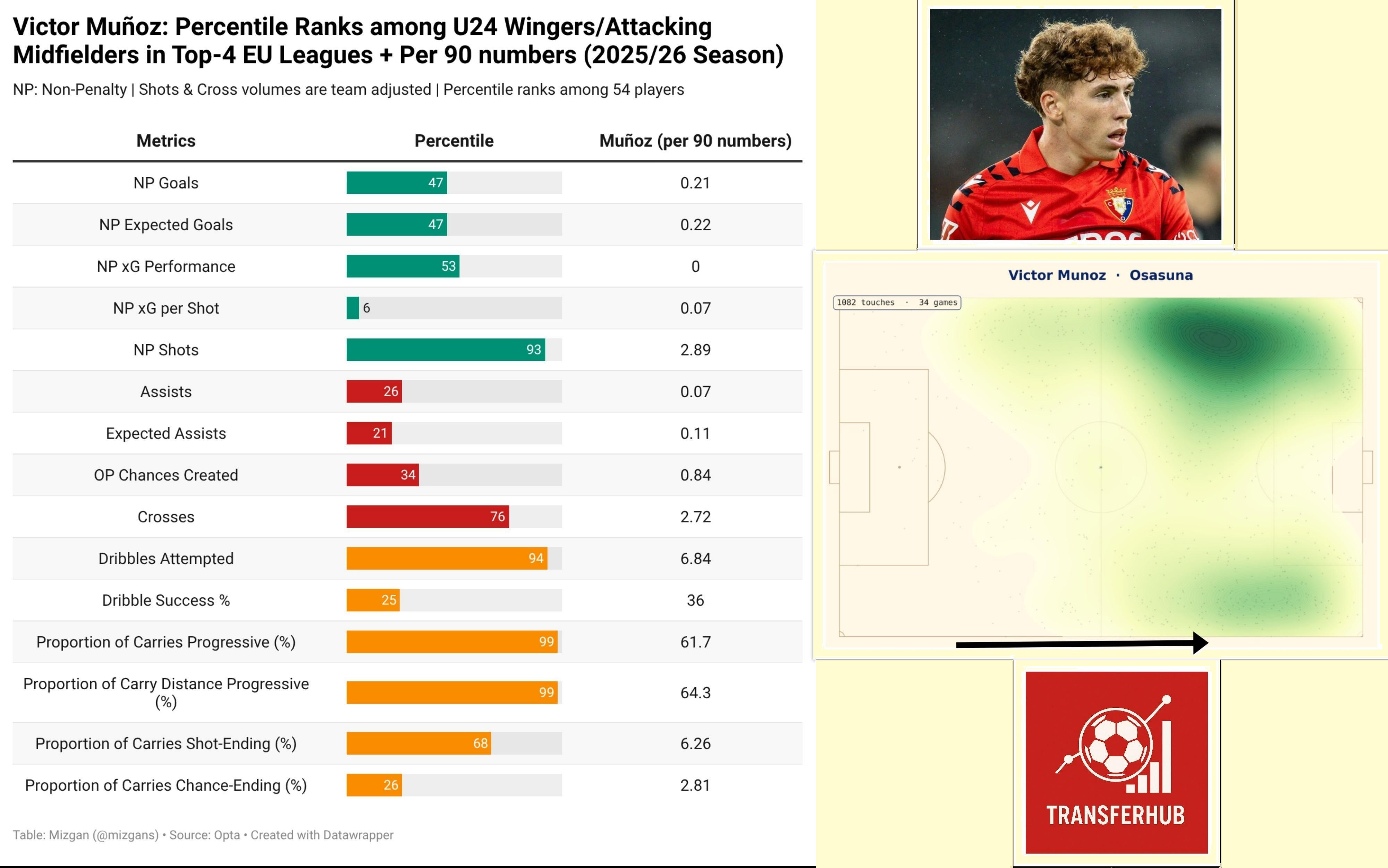
Shot and cross volumes are team adjusted to take into account the varying systems they play.
Despite playing for a team that averages fewer than 12 non-penalty (NP) shots per 90 minutes, Muñoz’s personal return of over 2.7 NP shots per 90 (2.89 when team-adjusted) marks him out as a high-volume shooter. He performs right on par when it comes to converting his expected goals, though his overall chance creation still has room for growth.
The 22-year-old pairs this directness with high-volume crossing and dribbling metrics. Among under-24 wingers in Europe’s top four leagues last season, only Lamine Yamal, Jérémy Doku and Yan Diomande attempted more dribbles per 90 minutes. Ranking in the highest possible percentile for both the proportion of carries and carrying distance being progressive shows how heavily his team relies on him to transition play up the pitch, and he is very good at it.
Next up, we have a visual analysis of what sort of runs he makes before receiving the ball in the final third or beyond.
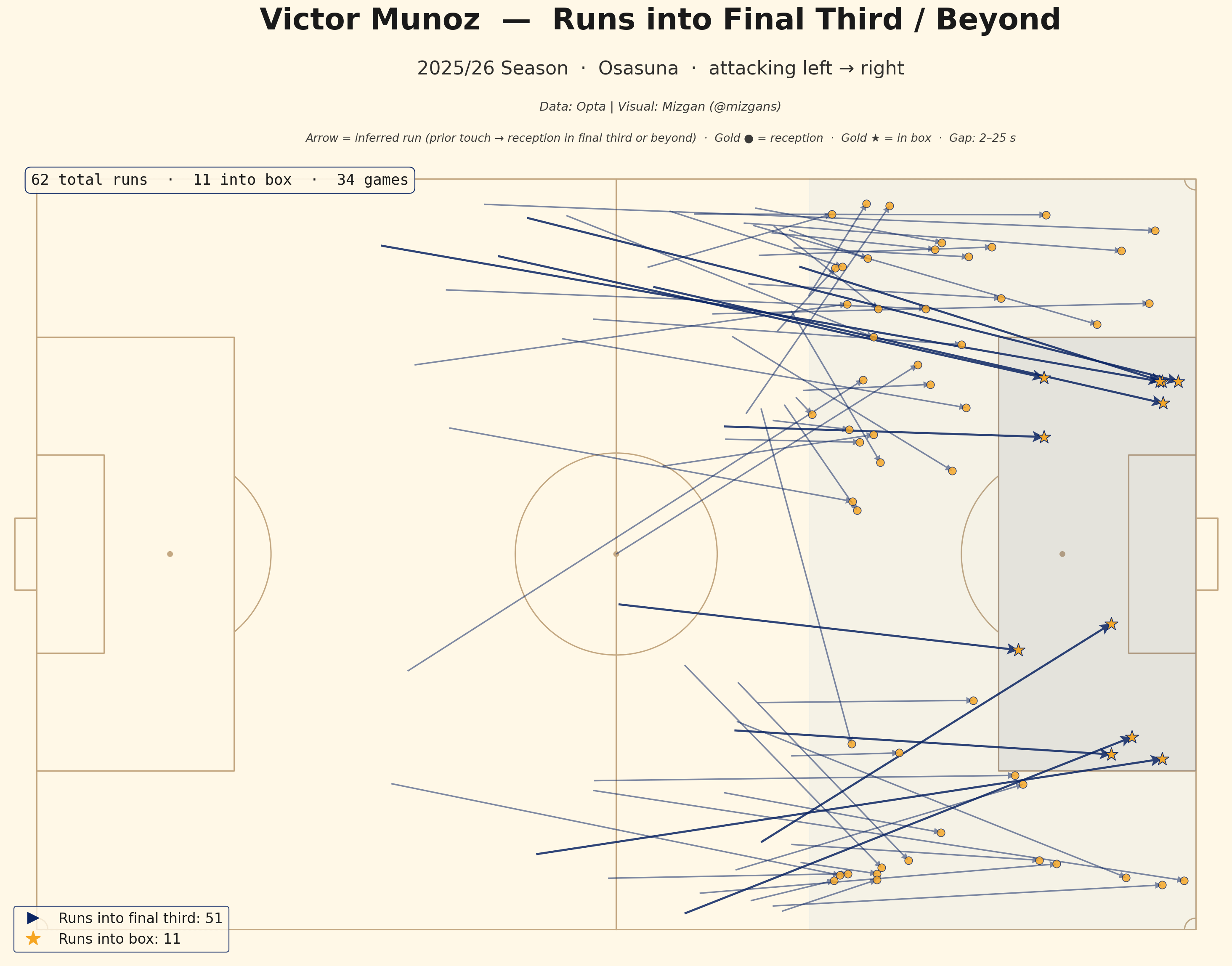
There is a decent mixture of long, bursting runs (team-dependent) and runs that take him closer to the byline before receiving the ball, from where he can take defenders on or put crosses into the box. Last season, he rarely made runs where he could receive the ball and be in a shooting position instantly. The idea is to stretch the opposition defence with these runs before supplying the ball into the box or into dangerous positions.
The numbers told us that the Spanish international is a high-volume dribbler. Let’s visualise that and see where his zones of dribbling are high.
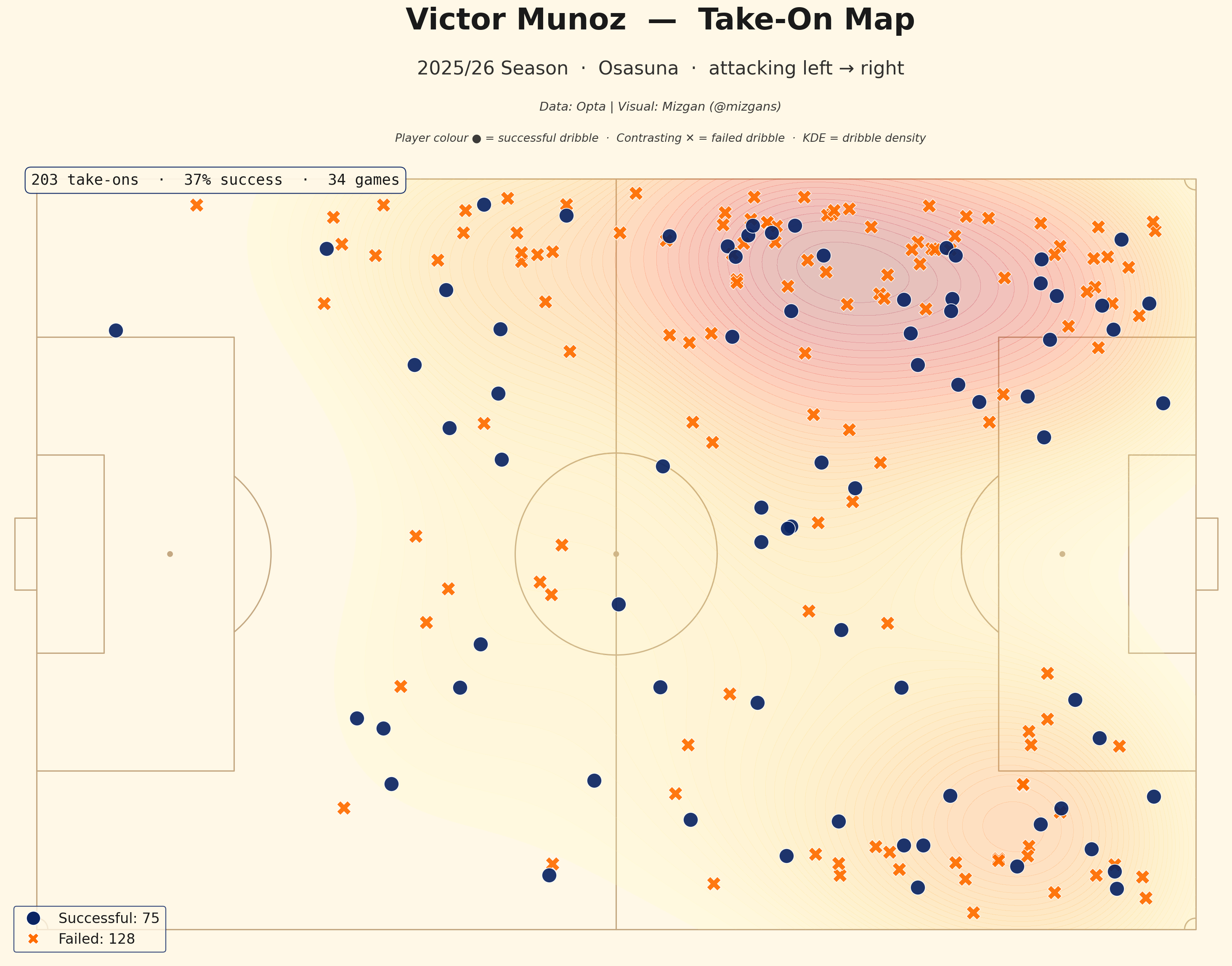
The answer is simple: pretty much everywhere on both sides of the pitch. With dribbles occurring both tight to the touchline and deep near the byline. It mirrors the pattern of his pre-reception runs into the final third. By doing that, he adds unpredictability to his play.
It is rare for an opposite-footed winger (right-footed wingers operating on the left and vice versa) to consistently drive towards the byline, as that is a trait usually portrayed by the elite, and Muñoz is comfortable making it a regular feature.
What does he do after completing a dribble (or a take-on)? The visual below shows that:
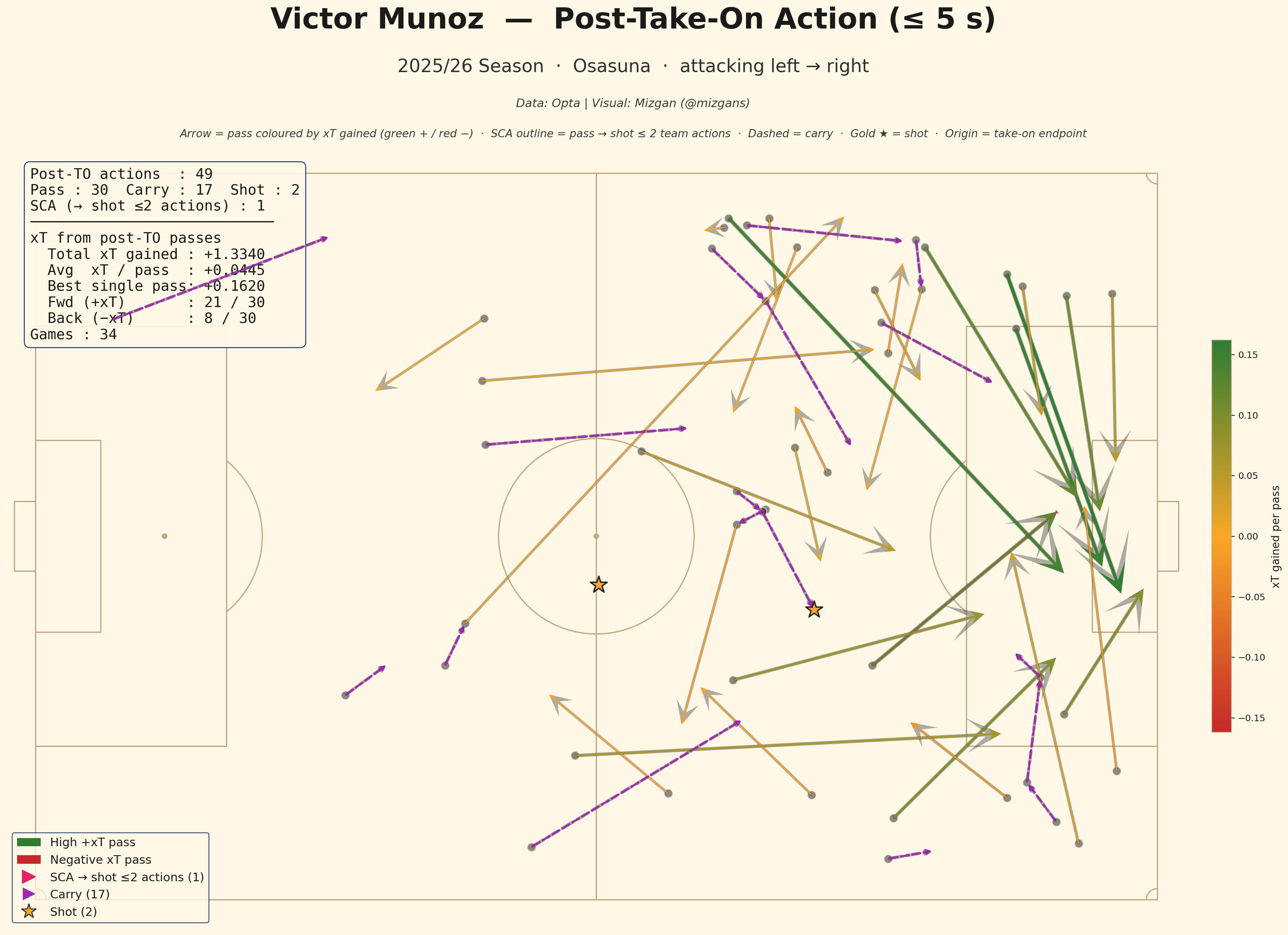
Around 35% of the time after completing a dribble, Muñoz carries the ball, mostly forwards. His post-dribble passes with the highest expected threat (xT) were played into the opposition box, close to the six-yard area (unsurprisingly).
This reiterates the idea of him playing a supporting role even after completing dribbles near the opponent’s box. At Osasuna, he was often connecting with the number nine, Ante Budimir (a penalty-box target man who scored 17 league goals last season). We could see Muñoz playing a similar role on the left at Anfield while connecting with the likes of Wirtz and Isak.
Next up, we have his progressive carrying map, which includes the speed at which he progresses the ball. Following that, we look at his xT via passes and crosses per zone, alongside a visual showing his passing tendencies and the teammates he connected with most frequently in the final third last season. Finally, we wrap everything up with some concluding thoughts on what to expect from the 22-year-old.
The rest of this article is for paid subscribers (only £3.50 to access six data-driven breakdowns, player and team analysis, and scout reports per month; £3.16 per month for an annual subscription).
Keep reading with a 7-day free trial
Subscribe to The Transfer Hub to keep reading this post and get 7 days of free access to the full post archives.